Choosing between a 5L, 10L and 20L oxygen concentrator is not simply a matter of buying the machine with the highest flow rate. For distributors, healthcare equipment suppliers, clinics, project contractors and OEM buyers, the right capacity depends on the intended application, required oxygen concentration at the target flow, outlet pressure, operating environment and local regulatory requirements.
A larger number does not automatically mean better performance. It indicates the maximum rated oxygen flow under specified operating conditions. Buyers still need to determine whether the machine can maintain the required oxygen concentration and pressure at that flow.
What Do 5L, 10L and 20L Mean?
The capacity normally refers to the maximum rated oxygen output in liters per minute, or LPM. A 5L unit can provide up to approximately 5 L/min, while 10L and 20L models provide higher maximum flow rates under their stated test conditions.
Capacity should not be confused with oxygen concentration. Two concentrators may have the same maximum flow but different oxygen concentration, outlet pressure, power consumption, noise level or continuous-duty capability.
For example, an individual model may maintain approximately 93% oxygen concentration at its rated flow, while another product may use a different performance range. Buyers should request the concentration specification across the full adjustable flow range rather than evaluating only the maximum number shown in the product name.
5L vs. 10L vs. 20L Oxygen Concentrators: Quick Comparison
| Capacity | Typical Procurement Position | Key Advantages | Points to Verify |
|---|---|---|---|
| 5L | Core model for homecare channels, retail distribution and standard single-outlet demand | Compact, lower power demand, easier transportation and broad market familiarity | Concentration at maximum flow, duty cycle, noise, alarms and local registration |
| 10L | Higher-flow option for professional supply channels, facilities and buyers needing more capacity | Greater flow range and broader application flexibility | Power consumption, pressure, heat management, continuous operation and outlet design |
| 20L | High-flow, commercial or project-based product for professional systems | Higher total oxygen output and potential integration into specialized equipment | System compatibility, pressure, installation, power supply, ventilation and technical support |
This table describes general procurement positioning, not universal technical specifications. Models from different manufacturers—and even products within the same capacity class—can perform differently.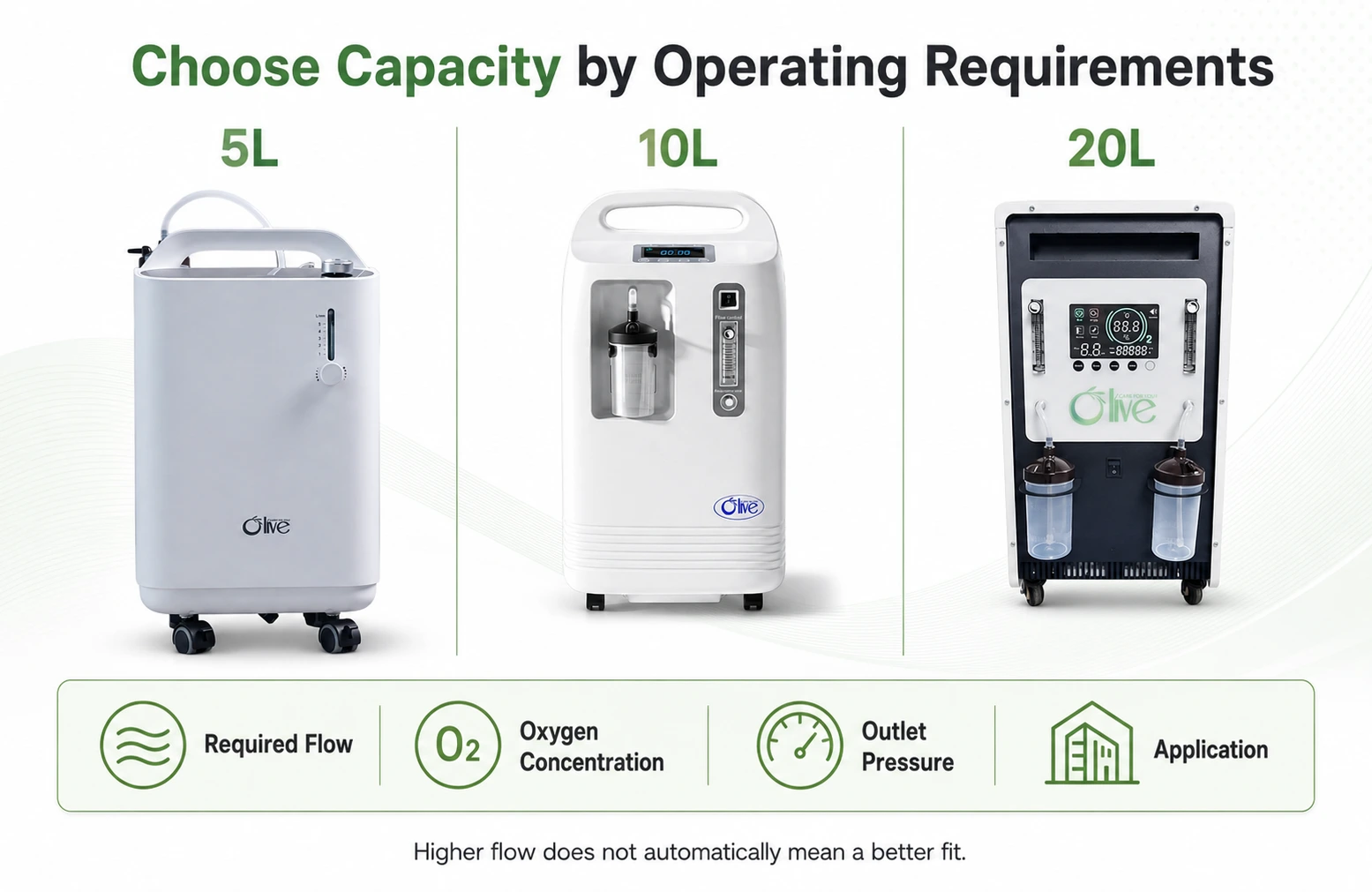
When Should Buyers Choose a 5L Oxygen Concentrator?
A 5L oxygen concentrator is often the starting point for distributors serving homecare equipment dealers, pharmacies, healthcare supply companies and other conventional oxygen equipment channels.
Common B2B advantages of 5L models
- Smaller footprint and easier placement in space-limited environments
- Lower shipping weight and storage requirements compared with larger units
- Lower electrical load in many product designs
- Established demand in homecare and medical equipment distribution channels
- Suitable as a core-volume product for regional distributors
As one model example, the OLIVE OLV-5S 5L oxygen concentrator lists an adjustable flow of 0–5 L/min and an oxygen concentration range of 90%–96%. The page also lists a two-year warranty and customization support. These figures apply to this specific model and should not be treated as standard specifications for every 5L machine.
When a 5L unit may not be enough
A 5L model may be unsuitable if the connected equipment requires more than its available flow or needs pressure above the machine’s rated outlet pressure. Buyers should also avoid assuming that one 5L machine can reliably support multiple outlets simply by adding a splitter.
If two outlets are required, select a model engineered with independent flow controls and verify the available flow and concentration at each outlet.
When Should Buyers Choose a 10L Oxygen Concentrator?
A 10L oxygen concentrator provides additional flow capacity for buyers whose customers need more than a standard 5L configuration. It can also help distributors cover a wider range of project requirements without moving immediately to a larger 20L platform.
Common B2B advantages of 10L models
- Higher maximum flow for more demanding equipment configurations
- Greater flexibility for clinics, professional facilities and institutional supply projects
- A useful higher-capacity option in a distributor’s product range
- Potential availability of higher-pressure or dual-flow configurations, depending on the model
For example, the OLIVE OLV-10 10L oxygen concentrator lists an output pressure of 20–60 kPa, operating noise below 50 dB and a net weight of 20 kg. These values are model-specific and should be confirmed in the latest technical datasheet before purchase.
Questions to ask before upgrading from 5L to 10L
- Does the application actually require more than 5 L/min?
- What oxygen concentration is maintained at 10 L/min?
- What outlet pressure does the connected equipment require?
- Will the machine operate continuously or intermittently?
- Can the installation site support the unit’s electrical load and ventilation needs?
If the application requires only modest flow, a 10L machine may add cost, size and power consumption without producing a practical benefit. Capacity should therefore follow the actual operating requirement.
When Should Buyers Choose a 20L Oxygen Concentrator?
A 20L oxygen concentrator is generally intended for high-flow professional applications, commercial projects or integration with compatible oxygen systems.
Potential buyers may include hospital equipment suppliers, clinic project contractors, rehabilitation equipment distributors, hyperbaric equipment companies and other specialized system integrators. The exact use depends on the model’s output pressure, concentration, electrical configuration and intended-use documentation.
Common B2B advantages of 20L models
- Higher total oxygen production for demanding applications
- Better positioning for institutional and project-based procurement
- Potential integration with compatible professional equipment
- Reduced need to combine several lower-capacity machines when one properly specified unit can meet the requirement
One OLIVE 20L oxygen concentrator model lists a rated flow of 0–20 L/min, oxygen concentration of 93% ±3%, output pressure of 20–60 kPa and a power rating of 1600 VA. It also lists a power-failure alarm and a two-year warranty. These specifications apply only to the product shown on that page.
20L concentrators for hyperbaric chamber projects
Some 20L oxygen concentrators are configured for use with compatible hyperbaric chamber systems. However, not every 20L machine is suitable for a hyperbaric chamber.
The OLV-20S high-flow oxygen concentrator, for example, is presented as a hyperbaric chamber configuration with a maximum flow of 20 L/min, oxygen concentration of 93% ±3% and an optional high-pressure configuration of up to 350 kPa.
Before purchasing for this purpose, buyers must verify the chamber manufacturer’s required flow, inlet pressure, connection method and oxygen delivery design. The concentrator should not be selected solely because its product name includes “20L.”
Seven Specifications B2B Buyers Should Check
1. Oxygen concentration at the required flow
Ask for oxygen concentration data at the intended operating flow—not only at a low-flow setting. A supplier should be able to explain the rated concentration range and the conditions under which it is measured.
2. Outlet pressure
Flow and pressure are different specifications. A machine may provide sufficient liters per minute but still fail to meet the inlet-pressure requirement of connected equipment. Applications involving hyperbaric chambers, filling systems or specialized respiratory equipment may require a specific pressure configuration.
3. Continuous-duty performance
Confirm whether the concentrator is designed for the intended daily operating schedule. Commercial sites may require longer operating periods than typical homecare environments.
Ask the supplier about recommended operating time, cooling design, temperature limits, preventive maintenance and expected sieve-bed service conditions.
4. Single-flow or dual-flow design
A dual-flow machine is not simply a standard concentrator with an external splitter. Proper dual-flow models should have independently adjustable flow meters and clearly stated total-output performance.
OLIVE offers a dual-flow oxygen concentrator configuration for buyers who require separate outlets. Confirm the flow available from each outlet, the combined maximum flow and concentration under simultaneous operation.
5. Electrical and environmental requirements
Check the destination market’s voltage, frequency and plug requirements. Buyers should also evaluate:
- Rated and peak power consumption
- Operating temperature and humidity range
- Required ventilation clearance
- Noise level at the intended installation site
- Altitude-related performance limitations
6. Alarms and monitoring
Depending on the market and intended use, buyers may need power-failure, low-oxygen, high-temperature, pressure or system-fault alarms. Confirm which alarms are standard and which are optional.
Do not rely on product appearance alone. Two similar cabinets may contain different alarm systems and internal configurations.
7. Documentation, registration and after-sales support
For wholesale and institutional procurement, the machine is only one part of the purchase. Buyers should also review:
- Applicable product certificates and quality-system documentation
- Destination-market registration requirements
- User manuals, labels and packaging languages
- Spare-parts availability
- Warranty scope and response procedures
- Remote training and technical support
- OEM and ODM capabilities
OLIVE provides manufacturing, customization and technical support for international oxygen equipment buyers. Companies comparing supply options can review the bulk oxygen concentrator ordering guide before preparing an inquiry.
Can One High-Capacity Concentrator Serve Multiple Users?
Not automatically. Dividing a stated maximum flow by the number of users is an oversimplified and potentially unsafe purchasing method.
Whether a concentrator can support multiple outlets depends on:
- Whether the model is engineered and documented for multi-outlet operation
- Total simultaneous flow demand
- Oxygen concentration at that combined flow
- Independent flow-control capability
- Outlet pressure under load
- Local regulations and applicable clinical requirements
For example, a 10L label does not prove that a machine can supply two independent 5 L/min outlets while maintaining its rated concentration. That performance must be confirmed by the manufacturer.
How Distributors Can Build the Right Product Portfolio
Many distributors do not need to choose only one capacity. A tiered product portfolio can address different purchasing budgets and application requirements.
| Portfolio Level | Suggested Role | Typical Buyer Need |
|---|---|---|
| 5L core model | Volume product | Compact design, conventional flow range and accessible procurement cost |
| 10L upgrade model | Higher-capacity option | More flow flexibility and professional-use positioning |
| 20L project model | Specialized product | High-flow systems, institutional procurement or equipment integration |
This structure helps distributors avoid forcing every customer into the same specification. It also creates a clearer upgrade path while keeping technical selection tied to actual demand.
Portfolio decisions should also reflect local market conditions
- Common prescriptions and purchasing patterns in the target market
- Local medical-device classification and registration
- Electricity supply and voltage stability
- Distributor service capability
- Shipping cost and warehouse capacity
- Demand from homecare, clinic and equipment-integration channels
What Information Should Buyers Include in an RFQ?
A detailed request for quotation helps the manufacturer recommend an appropriate model and reduces delays caused by repeated specification checks.
- Required maximum flow in L/min
- Required oxygen concentration at that flow
- Required outlet pressure
- Single-flow or dual-flow requirement
- Daily operating hours and expected duty cycle
- Intended application and connected equipment
- Destination country
- Voltage, frequency and plug type
- Required alarms and accessories
- Certification or registration requirements
- Estimated order quantity
- OEM logo, packaging or software requirements
If the concentrator will connect to another machine, include that machine’s inlet specification or technical datasheet. This enables the supplier to check both flow and pressure compatibility.
Frequently Asked Questions
Is a 10L oxygen concentrator better than a 5L model?
Not necessarily. A 10L model provides more maximum flow, but a 5L concentrator may be more appropriate when the application requires lower flow, a smaller footprint or lower electrical demand. The correct choice depends on the required performance.
Does a 20L oxygen concentrator produce purer oxygen?
No. The 20L rating describes flow capacity, not higher oxygen purity. Oxygen concentration must be checked separately at the intended operating flow.
Can a 10L concentrator replace two 5L machines?
Possibly, but only if the 10L model is designed for the required outlet arrangement and can maintain the specified concentration, flow and pressure under simultaneous load. Two independent machines may also offer redundancy that one machine cannot provide.
Can any 20L oxygen concentrator be used with a hyperbaric chamber?
No. Compatibility depends on the chamber’s oxygen flow, pressure, inlet and delivery-system requirements. A model specifically configured for the chamber system should be selected after technical verification.
What is the most important specification for wholesale buyers?
There is no single specification that determines suitability. Buyers should evaluate oxygen concentration at the required flow, pressure, duty cycle, alarms, power supply, documentation and after-sales support together.
Should distributors stock all three capacities?
That depends on local demand. A 5L model can serve as the core product, a 10L model as the higher-flow option and a 20L model for project-based inquiries. Actual inventory should reflect sales data, registration cost and service capability.
Final Buying Recommendation
The main difference between 5L, 10L and 20L oxygen concentrators is available flow capacity, but flow alone does not determine whether a product is suitable.
A practical B2B selection process starts with the application and then verifies oxygen concentration, pressure, operating schedule, electrical requirements, alarms and documentation. In general, 5L models fit core distribution channels, 10L models provide a higher-capacity upgrade and 20L units address more specialized or project-based requirements.
Before placing a bulk order, request a current datasheet and confirm performance at the intended operating point. If the concentrator will connect to other equipment, ask both manufacturers to verify compatibility.
Need Help Selecting the Right Capacity?
Tell OLIVE your required flow, pressure, application, destination market and order quantity. Our team can recommend suitable 5L, 10L or 20L configurations and discuss OEM, documentation and bulk-order requirements.
Request a B2B Recommendation